The Toughest Mountain
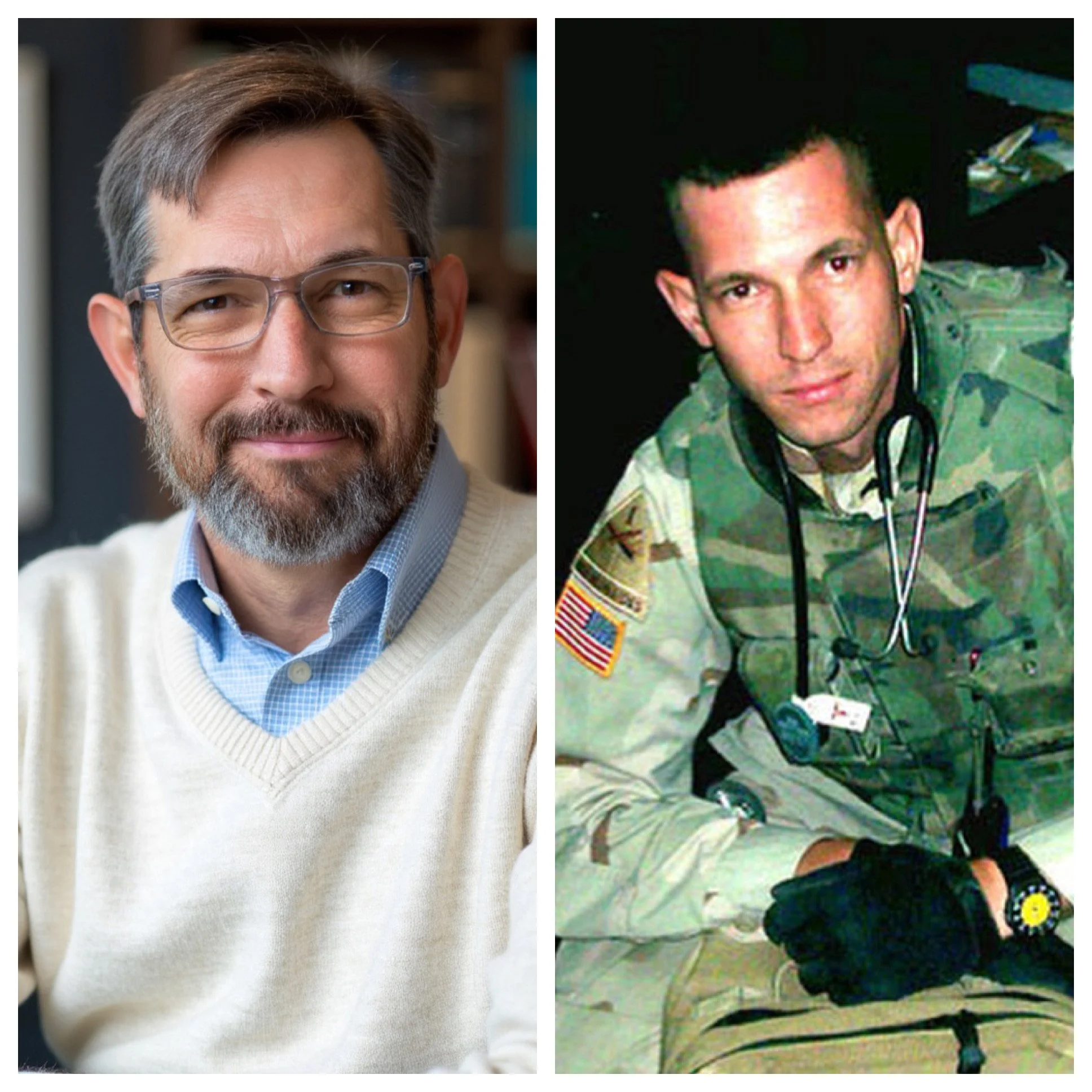
The stark differences between “now” and “then”. A lot can hide behind a smile…
The toughest mountain I have ever had to climb wasn’t a mountain. It was a transition. And, like most difficult climbs, it has been marked by false summits, exposed traverses, places where I needed to stop and establish a belay, and moments when I needed the strength of a good rope team to keep moving upward.
I thought I had completed the climb thirteen and a half years ago. I was wrong. When I left the military, the physical transition was relatively easy. I found a job. We moved our family. I began a new chapter. From the outside, it looked like success. The mental transition took longer.
At first, civilian life felt like freedom. There was a new job, a new home, new opportunities, and the excitement that comes with beginning again. For about a year, I was carried by the momentum of it all.
Then the romance began to fade. The loss of identity did not arrive like an avalanche. It came quietly. Almost imperceptibly. A little at a time.
In Alaska, I was still surrounded by the military. We lived in Eagle River, close to Joint Base Elmendorf-Richardson. The culture was familiar. The uniforms were familiar. The sounds were familiar. The military was still all around me.
So I found ways to remain connected. I formed Remedy Alpine to help veterans facing PTSD and the challenges of transition. Later, I started the Bullets 2 Beans podcast, creating conversations centered around military life, service, and the struggles that often follow.
I had left the military. But I had not really left the military community. And perhaps that made the transition easier.
After nine years, my civilian career took us away from Alaska and to Tucson, Arizona. That was when things began to change.
Tucson is technically a military town. Davis-Monthan Air Force Base is there. But the military presence did not permeate the community in the same way it had in Alaska.
The difference was subtle at first.
Then I shuttered the podcast. I became geographically separated from Remedy Alpine. The two passion projects that had kept me connected to the military community began to fade into the rearview mirror. And with them, something else began to disappear. A part of me.
There is a particular kind of identity crisis that can follow military service. I do not believe it is exclusive to veterans, but I do believe that those who have never served may have difficulty fully understanding it.
In the military, who you are is deeply connected to what you do. Your job is not simply a job. It becomes part of your identity. As a Combat Medic, I was “Doc.” That name carried weight. I was trusted. I was respected. I was responsible for the lives of the people around me. I had a place. And most importantly, I knew who I was.
Then I left.
I became a healthcare operations leader in a national company. I was successful. I had responsibility. I led people. I managed a significant operation. But outside of work, almost nobody knew what I did. And almost nobody knew who I had been. I had gone from being “Doc” to being another executive with a title that meant very little to anyone outside of my organization.
It was a difficult realization. I had not become less successful. But I had become less known. And, over time, I began to wonder if I had also become less important.
After two years in Tucson, we moved again. This time, to Hickory, North Carolina. If Alaska had allowed me to remain connected to the military community, Hickory has done the opposite. Here, I am about as far removed from that culture as I have ever been. The nearest TRICARE provider available to my wife is in South Carolina. She literally has to cross state lines to receive military healthcare.
The distance is more than geographic. It is cultural. It is emotional. It is the distance between the life I once knew and the life I now live. And it is here, after thirteen and a half years of retirement, that some of the hardest parts of military transition have finally begun to surface.
I feel isolated. Sometimes, I feel alone. I find myself looking for a fire team. Looking for a tribe. Looking for that shared understanding that comes from having endured something difficult with other people.
There is a certain comfort in not having to explain everything. In knowing that the people around you understand the things you do not say. I miss that. And I am beginning to understand that perhaps I have spent much of the last thirteen years trying to replace it.
I tried to stay connected. I built organizations. I started a podcast. I stayed involved. I kept one foot in the world I had left. But eventually, the distance became too great. And now I find myself standing somewhere between two worlds.
I am no longer the person I was in the military. But I am not entirely comfortable with the person I became after leaving it.
That may be the real transition. Not finding my old identity. Not recreating the past. But accepting that the person I was is gone—and having the courage to discover who I am now.
The military transition I thought I had completed thirteen and a half years ago may have only been the first leg of the journey. Because sometimes the hardest part of a climb is not reaching the summit. Sometimes it is realizing that the summit you were climbing toward was never the one you actually needed to reach.
The toughest mountain I have ever had to climb wasn’t a mountain. It was learning how to keep climbing after I had left behind the people, the culture, and the identity that had once made me feel like I belonged.
And maybe the answer is not finding my old rope team. Maybe the answer is not trying to become “Doc” again. Maybe the next part of the climb is accepting that I am something different now. And maybe, somewhere along the way, I will find—or build—a new rope team. One that understands that the climb is not over simply because the uniform is gone.
Because some of us are still climbing.
